
🫀 Aortic Aneurysm & Aortic Dissection
Aortic aneurysms and aortic dissections are life-threatening vascular emergencies involving the largest artery in the body. Rapid recognition and intervention are critical in the emergency department.
🫀 Aortic Aneurysm vs Aortic Dissection
Emergency recognition patterns for CEN Exam preparation.
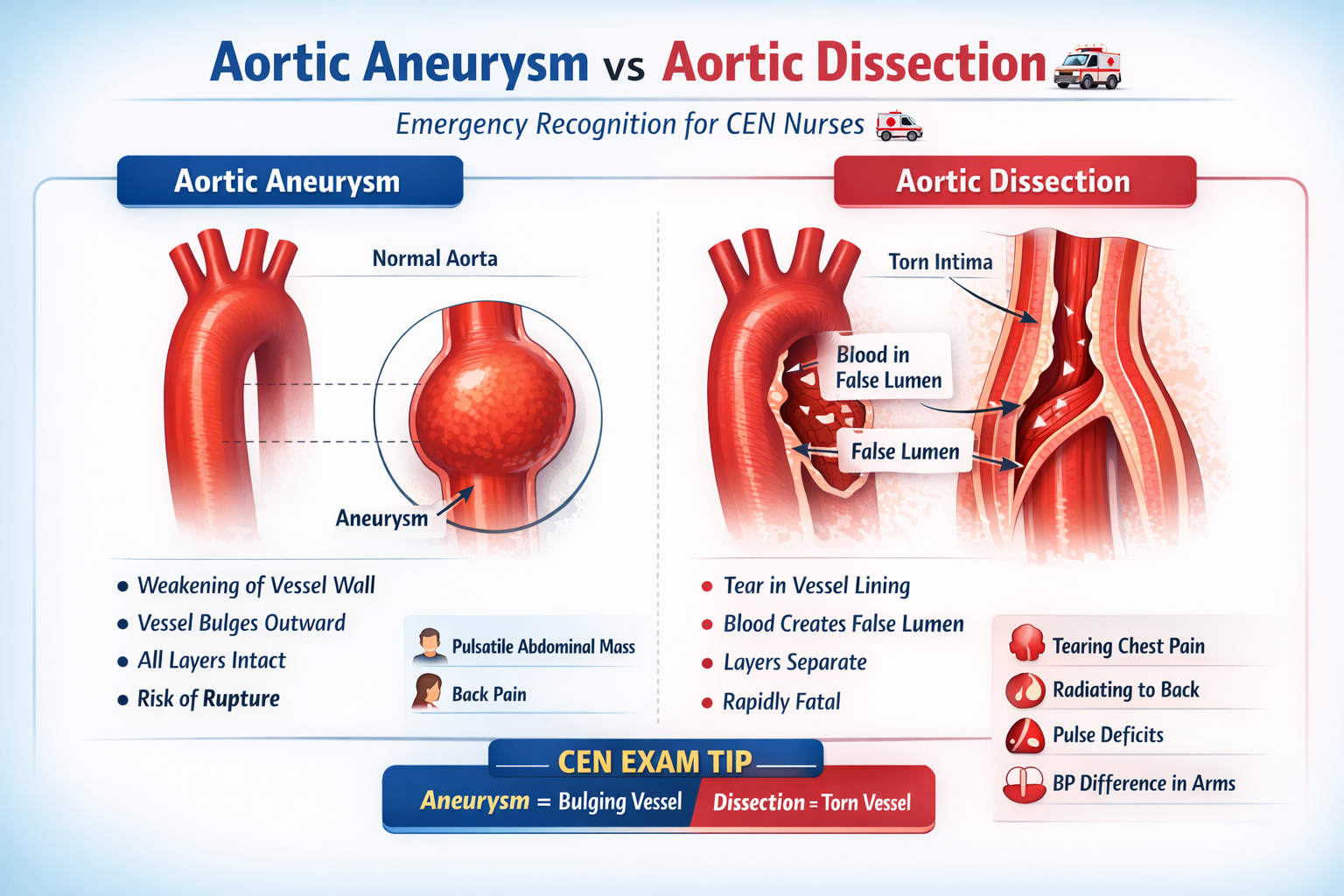
Both conditions involve damage to the aortic wall, but they occur through different mechanisms and present differently.
- 🚨 Aortic Aneurysm – dilation or ballooning of the aortic wall
- 🚨 Aortic Dissection – tearing of the inner layer of the aorta
🫀 Aortic Anatomy
The aorta is the largest artery in the body and carries oxygenated blood from the heart to the systemic circulation.
The aorta has several major sections:
- Ascending Aorta
- Aortic Arch
- Descending Thoracic Aorta
- Abdominal Aorta
The aortic wall consists of three layers:
- 🧬 Intima – inner layer
- 🧬 Media – muscular middle layer
- 🧬 Adventitia – outer connective tissue layer
Damage to these layers can lead to aneurysm formation or dissection.
⚙️ Aortic Physiology
The aorta functions as the main conduit for blood leaving the left ventricle.
Its elastic walls allow it to:
- Maintain blood pressure
- Absorb pulsatile cardiac output
- Deliver blood to systemic circulation
The aorta must withstand extremely high pressures generated during ventricular contraction.
Chronic stress on the vessel wall can weaken the aortic structure and lead to vascular disease.
🫀 Aortic Aneurysm
🚨 Pathophysiology
An aortic aneurysm occurs when the aortic wall becomes weakened and begins to bulge outward.
The most common cause is atherosclerosis, which weakens the vessel wall over time.
Other causes include:
- Hypertension
- Connective tissue disorders
- Smoking
- Trauma
- Genetic disorders (Marfan syndrome)
The aneurysm enlarges over time and may eventually rupture, leading to massive internal bleeding.
🧪 Clinical Presentation
Many aortic aneurysms are asymptomatic until rupture occurs.
Symptoms may include:
- ⚡ Sudden severe abdominal or back pain
- 🫀 Pulsatile abdominal mass
- 💔 Hypotension
- 😰 Diaphoresis
- ⚠️ Signs of shock
“Turn Phone Sideways to Take the (10) Question Exam.”
A ruptured abdominal aortic aneurysm is a true medical emergency with extremely high mortality.
📚 CEN Exam Insight – Aortic Aneurysm
The CEN exam frequently tests recognition of ruptured abdominal aortic aneurysm (AAA).
Classic exam presentation includes:
- Severe abdominal or back pain
- Pulsatile abdominal mass
- Hypotension
This combination is often referred to as the “classic triad” of AAA rupture.
⚠️ Aortic Dissection
🚨 Pathophysiology
An aortic dissection occurs when a tear develops in the intimal layer of the aorta.
Blood enters the tear and separates the layers of the aortic wall.
This creates a false lumen where blood flows between the vessel layers.
The dissection may extend throughout the aorta and block blood flow to major organs.
The most common risk factor is long-standing hypertension.
🧪 Clinical Presentation
Aortic dissection typically presents with dramatic symptoms.
Common findings include:
- ⚡ Sudden tearing chest pain
- ⚡ Pain radiating to the back
- 🩸 Blood pressure differences between arms
- 🫀 New heart murmur
- ⚠️ Signs of shock
Patients often describe the pain as “ripping” or “tearing.”
🧠 Stanford Classification
Aortic dissections are commonly classified using the Stanford system.
- Type A – involves the ascending aorta (surgical emergency)
- Type B – involves the descending aorta
Type A dissections are associated with a significantly higher mortality rate.
🚑 Emergency Nursing Management
Rapid identification and stabilization are essential.
Emergency management focuses on:
- Continuous cardiac monitoring
- Blood pressure control
- Pain management
- Preparation for emergency surgery
The goal is to reduce stress on the aortic wall by lowering blood pressure and heart rate.
📚 How Aortic Dissection Appears on the CEN Exam
The CEN exam frequently tests the nurse’s ability to differentiate aortic dissection from other causes of chest pain.
Common exam clues include:
- 🧠 Sudden tearing chest pain
- 🧠 Pain radiating to the back
- 🧠 Unequal blood pressures in the arms
- 🧠 History of severe hypertension
Example exam concept: A patient presenting with sudden tearing chest pain radiating to the back and unequal arm blood pressures should be suspected of having an aortic dissection.
⭐ Key Takeaways for CEN Candidates
- Aortic aneurysms involve weakening and dilation of the aorta.
- Aortic dissections involve a tear in the intimal layer of the aorta.
- Both conditions can rapidly become fatal without treatment.
- Emergency nurses must recognize symptoms quickly and initiate rapid stabilization.
Understanding aortic emergencies is essential for success on the CEN examination and for saving lives in the emergency department.

Learn Emergency Medicine From Someone Who Has Lived It
For more than 35 years in emergency medicine, Jeffery Bratcher has worked in environments where seconds matter, prioritization saves lives, and clinical judgment must be immediate.
The CEN® exam tests that exact type of thinking. Elite CEN Prep was built to train emergency nurses to recognize patterns, prioritize care, and answer exam questions the same way experienced ER clinicians think.
This is not memorization. This is clinical reasoning training for emergency nurses.
Train Your Brain to Think Like a Certified Emergency Nurse
The CEN® exam costs nearly $380–$450.
Elite CEN Prep gives you a complete certification system including
2,100+ questions with rationales, 6 full-length exam simulations, and deep-dive training videos.
The full price of Elite CEN Prep will soon increase to $97 as new training modules and content are added.
Secure your access now and lock in the $67 founding price before the increase.
🔥 Start Elite CEN Prep Now ($67)
📚 Take the Timed CEN Simulation (150 Questions) $15 Dollars